“I am no Jedi.”
— Ahsoka Tano, Star Wars Rebels
One of the smallest decisions I’ve made while designing conversational AI turned out to be one of the most interesting.
Two words. “I” and “we”.
Not exactly headline-grabbing stuff. Hardly the sort of thing you’d expect to cause much debate when you’re building an LLM to help people make sense of their finances. But I’ve learnt that these tiny words can completely change how someone experiences an AI. And, slightly annoyingly, they’re not nearly as straightforward as I first thought.
From using AI to actually designing one
When I started working on the system prompt for Aurora, I’d never written one before. I’d heard of system prompts. I understood what they did. And as someone who enjoys exploring AI, I’d spent a fair amount of time experimenting with prompts to get better results.
But there’s a big difference between using AI and designing how one should behave. Suddenly, I wasn’t just thinking about outputs. I was thinking about identity, tone, boundaries, trust, decision-making, and how users might interpret what the system was saying, especially when it came to their money.
My instinct is usually to understand something properly before I begin. A sensible instinct in theory. Less helpful when it turns into a polite form of procrastination.
Working in product does not always give you the luxury of becoming an expert first and doing the work second. Sometimes you learn by getting into it. So I did.
Aurora had already been defined as a guide. The user was the hero. Aurora’s role was to help people understand their finances, make sense of their options and move forward feeling more confident. That's where “we” entered the picture.
The comfort of “we”
At first, “we” felt like the obvious choice. “We’ll help you understand your finances.” “Together, we’ll build a plan.” “We’ll help you feel more confident about your future.”
It sounded collaborative, reassuring and supportive. It also reflected the brand. There was something comforting about it, particularly in a financial context where users can feel uncertain or overwhelmed. And I think that is why so many companies default to “we”. It feels safe. It feels friendly. It feels like the digital equivalent of standing beside someone and saying, “Don’t worry, we’ve got this.”
But then a question started niggling at me. Who exactly is “we”?
Is it the company? The AI? The product team? A group of financial experts? Or the user and the AI together?
At first, I thought that ambiguity was harmless. Then we tested the experience.
When the words stopped working
Watching people use something you’ve helped shape is always humbling. You can have a beautifully reasoned internal logic, and then a user quietly wanders in and pulls the whole thing apart in about four minutes.
During testing, we started to see that “we” was not always landing in the way we intended. What had felt reassuring to us sometimes felt vague to users. It blurred who was speaking and where the guidance was coming from. That is when things started to change for me.
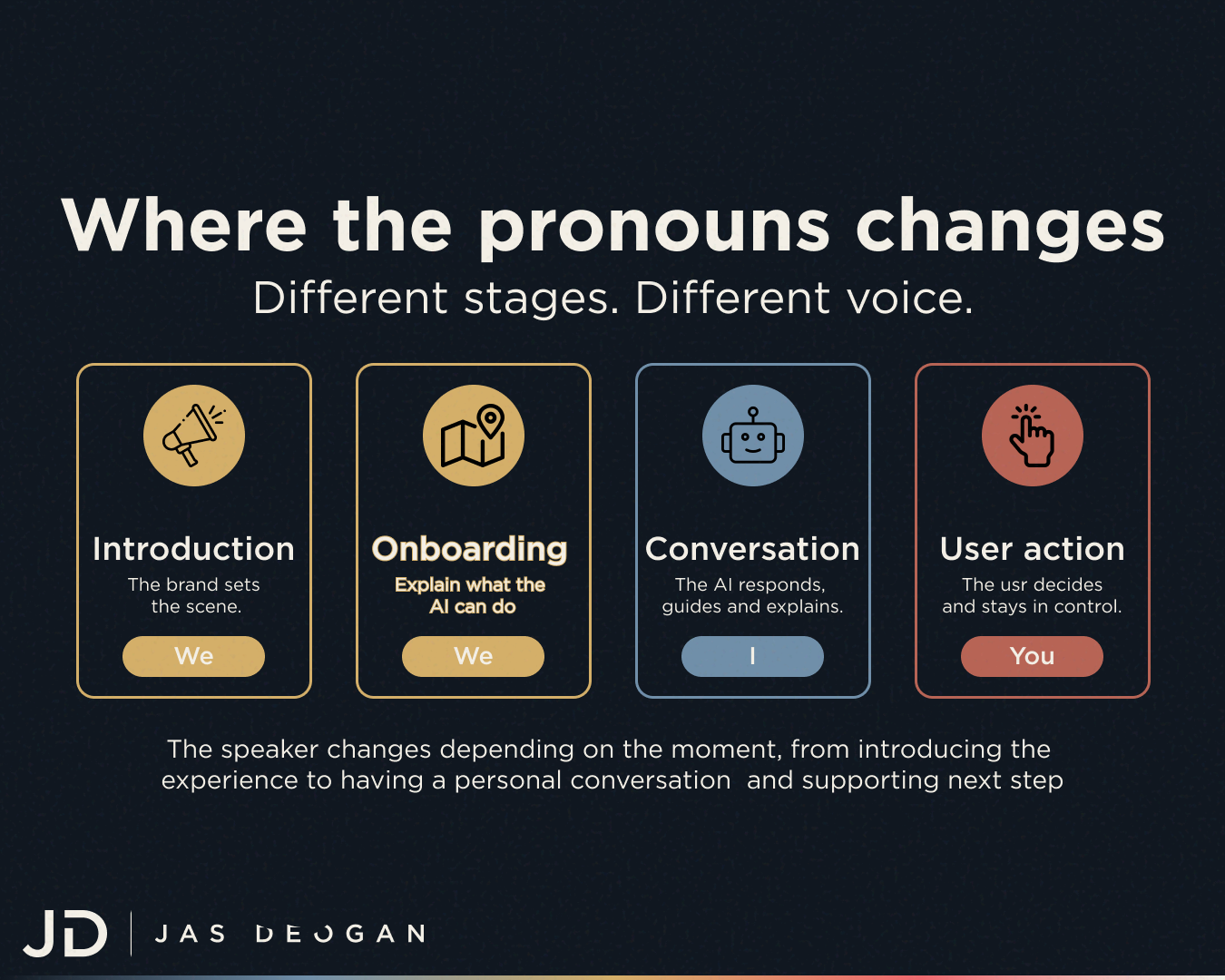
I realised our experience had two different modes. The first was static. It introduced Aurora, explained what the experience was for and set expectations. The second was dynamic. It was the conversation itself.
In the static parts, “we” still made sense. The brand was introducing the experience. But once the user entered the conversation, things shifted. They were no longer reading about Aurora. They were talking to it. And at that point, “we” started to sound less like support and more like a slightly nervous committee.
The three voices in the room
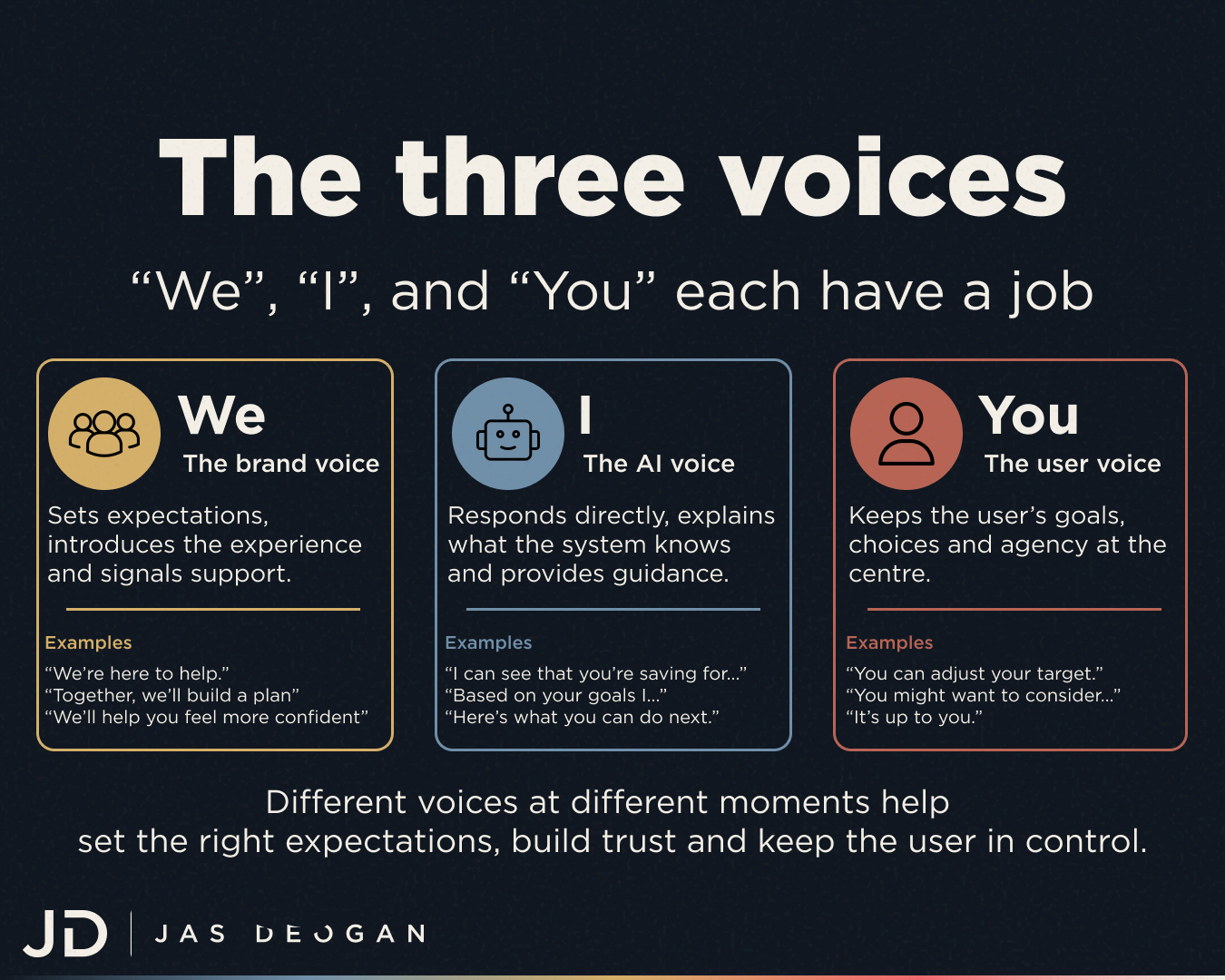
One thing I learnt quite quickly is that this is not really a battle between “we” and “I”. It is about understanding that “we”, “I” and “you” each have a different job to do.
“We” is the brand voice
“We” works well when the organisation is setting the scene, introducing the experience or explaining the support around it. For example:
“We’re here to help you understand your options.”
That makes sense in onboarding or introductory content because the brand is speaking.
“I” is the AI voice
“I” works better when the system is responding directly, interpreting information or guiding the user through a conversation. For example:
“I can see that you’re saving for a home.”
That makes the source of the response clearer. It gives the AI a distinct point of view.
“You” keeps the user visible
“You” matters because it keeps the user’s goals, choices and agency at the centre. For example:
“You can adjust your target if your plans have changed.”
That sounds simple. But it isn’t.
Because once you start thinking this way, pronouns stop being a copy detail and start becoming part of the relationship design.
“We” sets context.
“I” takes responsibility for the response.
“You” keeps ownership where it belongs, with the user.
Giving Aurora its own voice
This is why we shifted Aurora’s conversational language from “we” to “I”. For example:
“Based on your goal and the information you’ve shared, I can see that you’re saving towards your first home.”
It is a small shift, but an important one.
“I” helps Aurora feel like a clear speaker rather than an extension of generic brand copy. It reinforces the guide archetype and makes the response feel more direct and accountable.
This links closely to what I wrote in Why Your AI Needs an Archetype Before It Needs a Prompt.
An archetype is not just a personality exercise. It has to shape behaviour. It has to influence what the AI says, how it says it and what kind of relationship it forms with the user.
But I also learnt something else. “I” does not automatically create trust. It only works if the AI is clear about what it knows and what it is actually doing. Otherwise, you are just giving uncertainty a more confident outfit. And finance has enough overconfident voices already.
Giving the user an “I” too
What surprised me was that this shift also changed how I thought about user actions. Take something like: “Build a plan”
Perfectly clear. Perfectly usable. But in a conversational interface, something like: “I want to build my plan” does something slightly different. It mirrors the user’s intent.
The interface is no longer just presenting an action. It is helping the user articulate a choice. That can increase the sense of ownership, especially in a guidance experience where the goal is not to push the user towards a decision, but to help them feel more in control of one.
So now there are two first-person voices in play.
The AI says, “I can help.” The user says, “I want to act.” And “you” remains the connective tissue that keeps the user’s goals visible throughout.
Identity without pretending to be human
Of course, there is a line here.
If you give an AI a voice, there is always a risk of making it sound more human than it should. That is why guardrails matter.
Aurora can say: “I can see that your current saving rate may leave you short of your target.”
But it should not say: “I know how stressful that must feel.”
The first is a clear statement about what the system can infer. The second suggests a human emotional understanding it does not have.
The goal is not to make AI sound robotic. It is to make it sound natural without disguising what it is.
That is especially important in fintech, where the difference between guidance and advice matters, and where trust can be damaged very quickly if the system sounds more certain, more human or more authoritative than it really is.
This also connects to my thinking in Why AI Tone Needs to Read the Room. Not every interaction needs the same level of warmth or encouragement. Good conversational design is about judgement, not just personality.
Small words, bigger design decisions
Looking back, I thought I was making a copy decision. Really, I was helping define a relationship. Between brand and AI. Between AI and user. And between what the system says and what the user believes.
That is why I now think the more useful question is not “Should we use ‘I’ or ‘we’?” It is this:
Who is speaking here, what are they responsible for, and does the language make that clear?
Because in conversational AI, pronouns are not filler. They are signals. “We” tells the user who is welcoming them. “I” tells them who is responding. “You” reminds them whose goals, choices and future are actually at stake.
And if we get that balance wrong, the whole experience starts to wobble, no matter how polished the rest of it looks. Which is a fairly dramatic amount of responsibility for three very small words — don’t you think!