Content design is both a discipline and a practice
“Many of the truths that we cling to depend on our point of view.”
— Obi-Wan Kenobi, Return of the Jedi
Content design is often reduced to the things people can see.
The button label. The error message. The help article. The onboarding screen. The chatbot response. The line of copy someone wants “made clearer” before a product ships.
But that is only the visible part.
We all know, or designers know, that real work often happens before the words appear.
It is the thinking behind the words. The structure behind the journey. The evidence behind the decision. The intent behind the message. The questions we ask before we write anything at all.
That is content design, and it’s why I see content design as both a discipline and a practice.
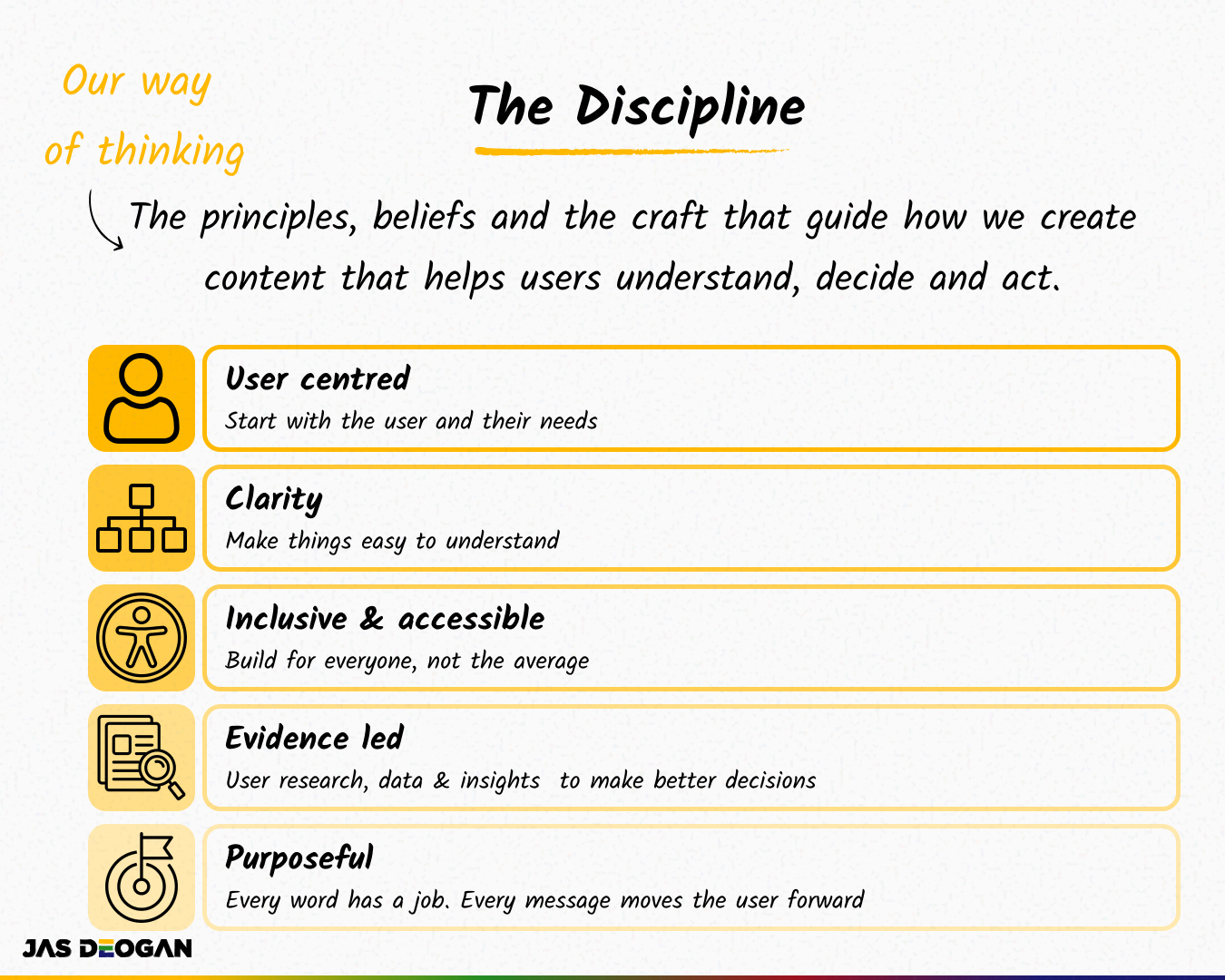
The discipline gives us the principles
As a discipline, content design gives us a way of thinking. It gives us principles, standards, craft and judgement. It teaches us to care about clarity, structure, accessibility, inclusion, usefulness, evidence and trust.
If you think about it, content design teaches us to ask better questions.
What does someone need to understand?
What are they trying to do?
What could confuse them?
What language will make sense to them?
What happens next?
What does good look like here?
Those questions are not tied to one job title. They are not limited to one format. They are not only useful when you are writing interface copy.
They matter in product journeys. They matter in help content. They matter in technical guidance. They matter in conversation design. They matter in AI prompts. They matter in campaigns, onboarding, service messages and content systems.
The medium may change. But the principles do not.
Content design shows up in more places than we think
That is why I think content design shows up in more places than we sometimes give it credit for.
You might be a content designer, UX writer, technical writer, conversation designer, content strategist, content manager, prompt designer, copywriter or content marketer. The output may look different. The tools may be different. The audience may be different. The label on the role may be different.
But much of the work still draws on the same content design principles: help people understand, decide, and act.
That does not mean every role is identical.
A technical writer may focus more on accuracy and instruction. A copywriter may focus more on persuasion and memorability. A content marketer may focus more on attention, growth and brand. A conversation designer may focus more on interaction, turn-taking and intent. A prompt designer may focus more on behaviour, constraints and outputs.
The craft shifts depending on the medium. But the shared foundation is still there.
Clarity matters. Structure matters. Evidence matters. User needs matter. Context matters. Intent matters. Accessibility matters. Language matters.
That, to me, is the discipline of content design.
It is the belief system behind the work.
The practice is where the work gets real
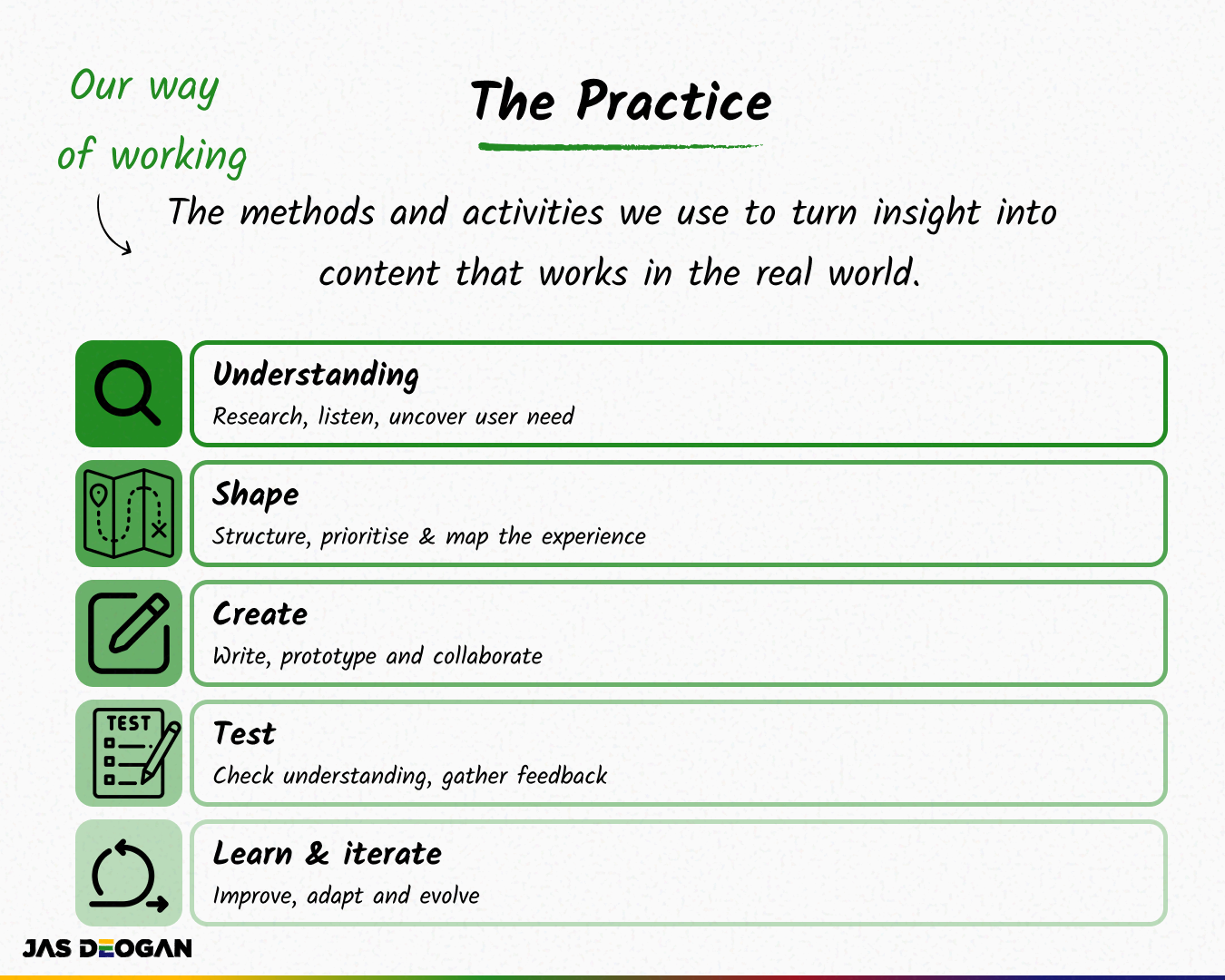
But content design is also a practice. And practice is where things get real.
The practice is the set of methods we may use to move from confusion to clarity. Research. Discovery. Audits. Journey mapping. Pair writing. Prototyping. Testing. Crits. Workshops. Governance. Iteration. Measurement.
But it is not a neat, linear process. It is not a perfect training sequence where you complete one step, unlock the next, and eventually become a master.
Real content design is messier than that.
You might start with research and realise the issue is structural. You might write a journey and discover that the language does not match how people think. You might audit a set of pages and uncover a governance problem. You might test a message and realise the words are not the issue. The whole journey is asking too much from the user.
You might be brought in to “make the words better” and end up helping the team see the problem differently.
That is not a distraction from content design. That is content design.
The craft lives in the judgment
The practice moves. It loops. It adapts. Sometimes you jump ahead. Sometimes you go back. Sometimes you need to stop and say, “I don’t think this is the problem we need to solve.”
That is where the craft lives. Because methods matter, but judgment matters more.
Knowing how to run an audit is useful. Knowing when an audit is the wrong starting point is better. Knowing how to write clear content is useful. Knowing when the content is exposing a broken journey is better.
AI makes the discipline more important
This matters even more now, as AI starts to blur the edges between roles.
More people can create content quickly. More teams can generate copy, prompts, help articles, chatbot responses and product messages in seconds. The galaxy is getting louder. The tools are getting faster. The outputs are multiplying.
But faster content does not always mean better content. Someone still needs to ask the human questions.
What does this mean?
Who is this for?
Will people understand it?
Can they act on it?
What could go wrong?
What happens next?
That is where content design becomes more important, not less. Because content design is not just about producing words. It is about shaping understanding. It is about reducing doubt. It is about making products, services and systems easier to use. It is about bringing structure to complexity.
The output is what people experience
The discipline gives us the principles. The practice gives us the moves. And the output is what people experience.
Sometimes that output is a button label. Sometimes it is a help article. Sometimes it is a chatbot flow. Sometimes it is a technical guide. Sometimes it is a prompt. Sometimes it is a campaign. Sometimes it is a content model or a design system pattern.
Different outputs. Different labels. Different mediums. The same force runs through the work.
Content design is a way of seeing
So yes, I think content design is both a discipline and a practice. But more than that, I think content design is a way of seeing.
It asks us to look beyond the words and understand the system around them. It asks us to care about what people need, what the business needs, and what the experience needs to do.
That is why it shows up everywhere. Not because every content role is exactly the same. But because good content works, whatever the label, it draws from the same core truth: Content is how people understand. Content is how people decide. Content is how people move forward.
That is not “just words”. That is content design