My first 90 days as a solo content designer
“The belonging you seek is not behind you. It is ahead.”
— Maz Kanata, The Force Awakens
A lot can happen in 90 days.
You can start a new role. Learn a new industry. Meet more people than your brain can realistically remember. Try to understand the acronyms everyone else uses casually. Sit in meetings where you follow 40% of what is being discussed and quietly hope the other 60% catches up later.
You can also begin again.
That has been the honest shape of my first 90 days, and the start of 2026.
After a brutal — and I mean brutal — job search, landing a role felt like relief. The kind that comes after months of rejection, silence, self-doubt and wondering whether the job market has moved on without you.
Getting the job was a huge moment.
But alongside the relief, I also felt lost. I questioned whether I deserved the opportunity. Whether someone would eventually realise they had made a mistake. Whether the rug was about to be pulled out from under me just as I had started to stand up again.
My confidence had taken a knock. And starting a new job was not going to repair that overnight. Confidence does not magically return because your email signature changes. I still carried the weight of what came before. I wanted to prove I was the right choice. I wanted to be useful quickly. But I also had to remind myself that being new did not make me less capable.
So my first 90 days were not just about onboarding. They were about finding my feet again. Rebuilding confidence through action. Recovering my voice through intent, connection and the work itself.
And, as the only content designer in the business, they were also about something bigger: building the practice while delivering within it.
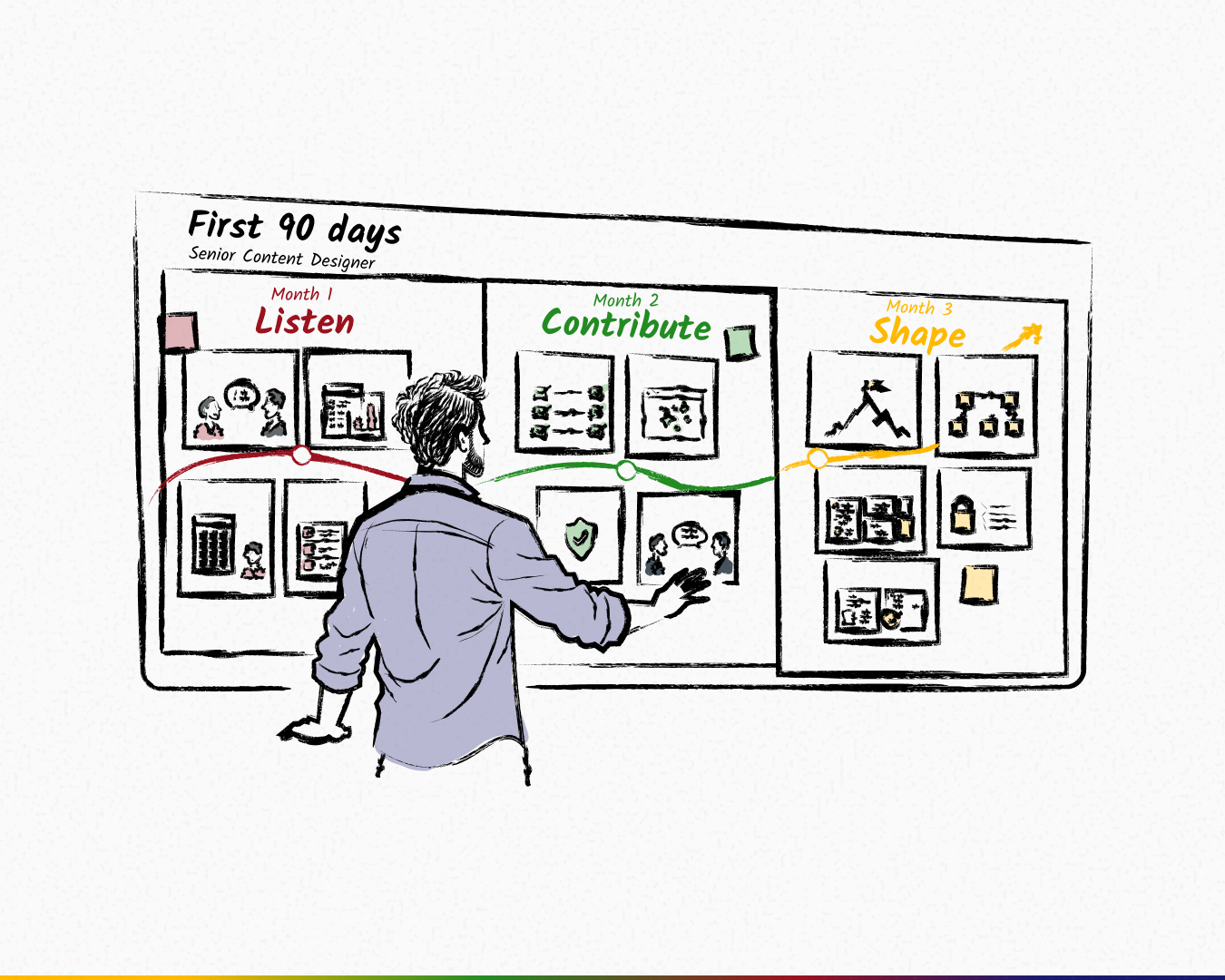
Month one: learning the room before changing it
My first month was about listening.
Not waiting. Not hiding. Listening. I was always taught that we have two ears and one mouth for a reason: we should spend more time listening than speaking. So that is what I did. I listened. I absorbed. I learnt.
At times, I wondered whether people saw my reserved silence as shyness. But I knew it was what I needed. I had to move at my own pace rather than march to the beat of someone else’s drum.
I had joined a fintech company where content had historically been shaped by product designers and reviewed by the content marketing team. And to be clear, there is nothing wrong with product designers writing. Everyone involved in shaping a product should care about language, clarity and how people move through an experience.
But content design is not just writing. That was one of the first things I had to work out how to explain. Before I could influence anything, I needed to understand how the business already worked.
So I spent the first month meeting people, attending project sessions, joining rituals, reading documentation and learning the product. I began to understand compliance, Consumer Duty, customer strategy and how content decisions were being made.
I met designers, researchers, product managers, marketers, compliance colleagues and people working across customer strategy and support. I started to see the handovers, the gaps and the moments where content was being brought into the process too late. I also saw where teams were already making thoughtful decisions without a content designer in the room.
That mattered.
Building a practice does not mean arriving and acting as though nothing good existed before you. It means understanding what is already working, recognising where people have been filling the gaps, and helping the organisation build on it.
That first month reminded me of something - I keep learning in different ways: You cannot build trust by performing expertise. You build trust by paying attention.
So I asked questions. I watched how teams talked about users. I looked at how projects were structured. I reviewed the design system. I learnt how customer strategy is connected to product journeys.
I tried to understand the system before attempting to change it. That is not passive work. It is how you read the room before stepping into the arena.
Month two: getting into the work
By month two, I had started moving from observer to contributor.
The work became more active and more complicated. I was not simply reviewing words or tightening bits of copy. I was getting involved in conversational UX, guidance flows, AI-related content requirements, content standards and journey-level decisions.
I worked with product designers and stakeholders to reduce friction in conversational journeys, while also starting to build the foundations of the practice. I explored how guidance should work when a system needs to support someone rather than simply instruct them. I began looking at AI tools and prompts not as clever shortcuts, but as experiences that needed structure, boundaries and accountability.
That is where the role began to stretch me.
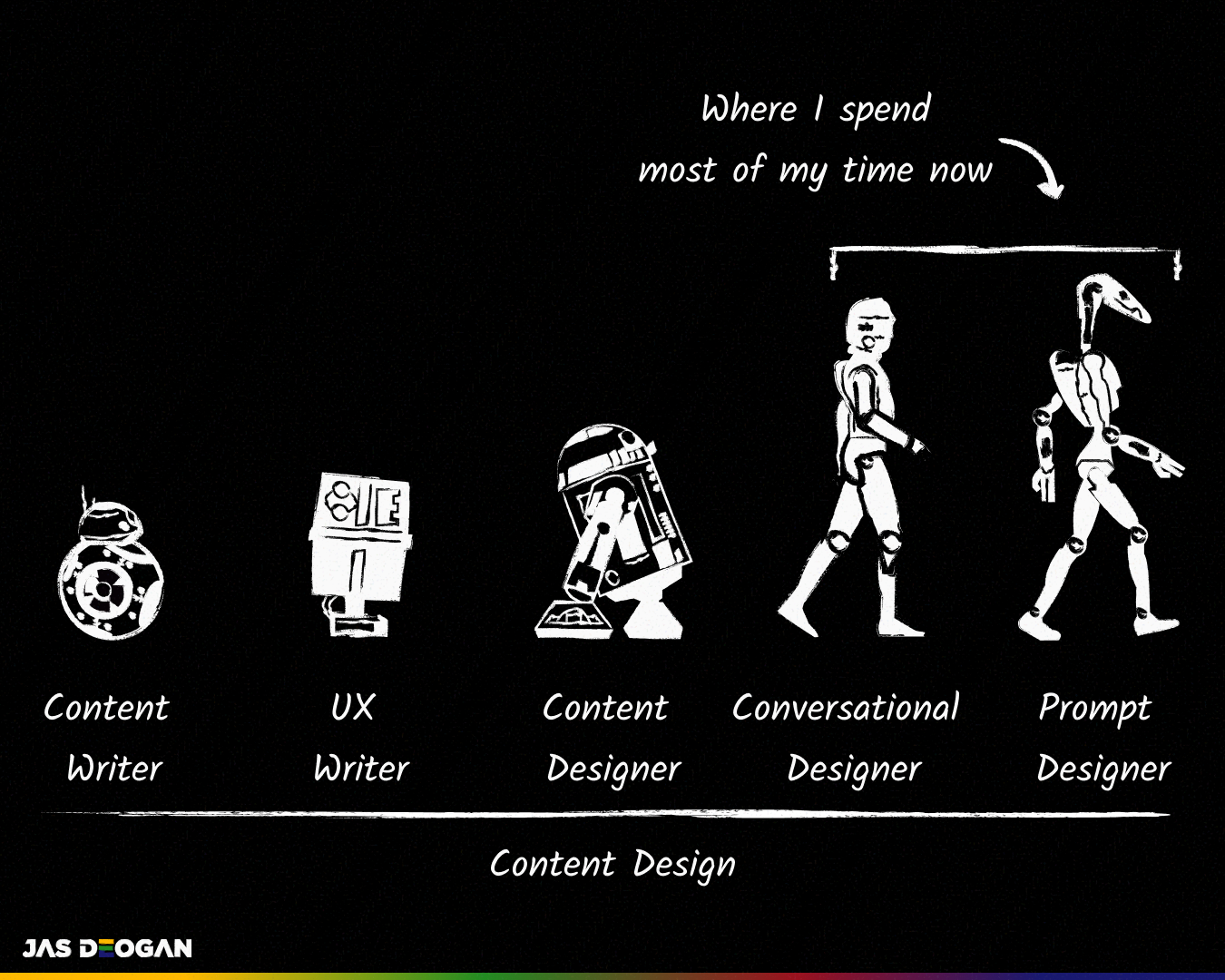
While I still call myself a content designer, much of my day-to-day work now sits within conversational design and prompt engineering. I am still designing with language, but the material has changed.
It is no longer just headings, labels, error messages and help text. It is prompts, responses, logic, escalation points, tone, intent, user behaviour and system boundaries.
For the work I do now, content is not simply what appears on a screen. It is dynamic. It shapes the interaction. That is a significant shift in the craft. And honestly, it is one I am still learning to navigate.
It is exciting. It is uncomfortable. Sometimes it is scary. I do not have all the answers, and I do not think pretending otherwise would make me a better content designer.
So I lean on others. I learn from designers, researchers, customer support, compliance, product and marketing. I ask for help. I test my assumptions. I let other people’s expertise change the work. That does not weaken the craft. It strengthens it.
There were days in month two when I felt energised by the work. There were also days when it felt as though I was holding several threads at once and trying not to drop any of them.
Compliance needed clarity. Marketing needed consistency. Product needed momentum. Design needed the experience to work. Customer support had direct insight into where users were struggling.
And somewhere in the middle, I was trying to make sure the content did what good content should do: help people understand, decide and act with confidence. Good content often disappears into the experience. But bad content is impossible to ignore.
Month three: turning delivery into a practice
By month three, I started to see the bigger picture. But I was also beginning to help build it.
The first month had been about context. The second had been about contribution. The third became about ownership. Not ownership in the heroic, “I fixed everything” sense. There was no dramatic reveal. No medal ceremony. No swelling soundtrack.
It was a more grounded form of ownership: recognising patterns, naming problems, documenting decisions and asking how the work could become more consistent and scalable.
I started thinking more seriously about content processes, conversational design principles, tone of voice, AI guardrails and system prompts. I began asking how guidance patterns could be reused and how content decisions could be explained rather than simply debated.
That last point matters, as content design can quickly become subjective when the rationale is unclear. One person prefers one word. Someone else prefers another. Compliance needs something safer. Marketing wants something warmer. Product wants something shorter. Design needs it to fit within the interaction.
Without a clear way to make decisions, content becomes a negotiation between preferences. Part of the content designer’s role is to move the conversation from preference to purpose.
What does the user need to understand?
What action are we supporting?
What risk are we reducing?
What behaviour are we shaping?
What needs to be clear now, and what can wait?
What happens if the user misunderstands this?
Those are the questions that turn wording into design.
They also reminded me that content design is not about having the strongest opinion in the room. It is about helping the room make a better decision.
Explaining the role became part of the role
Across the 90 days, one question kept coming up: What does a content designer actually do?
I understand why. Content design is still unfamiliar to some people. And if I am honest, I do not think we have always explained the discipline particularly well.
For a while, I reached for the accurate definition. The one that makes sense to people who already understand the practice - But it did not always land.
So I changed the way I explained it.
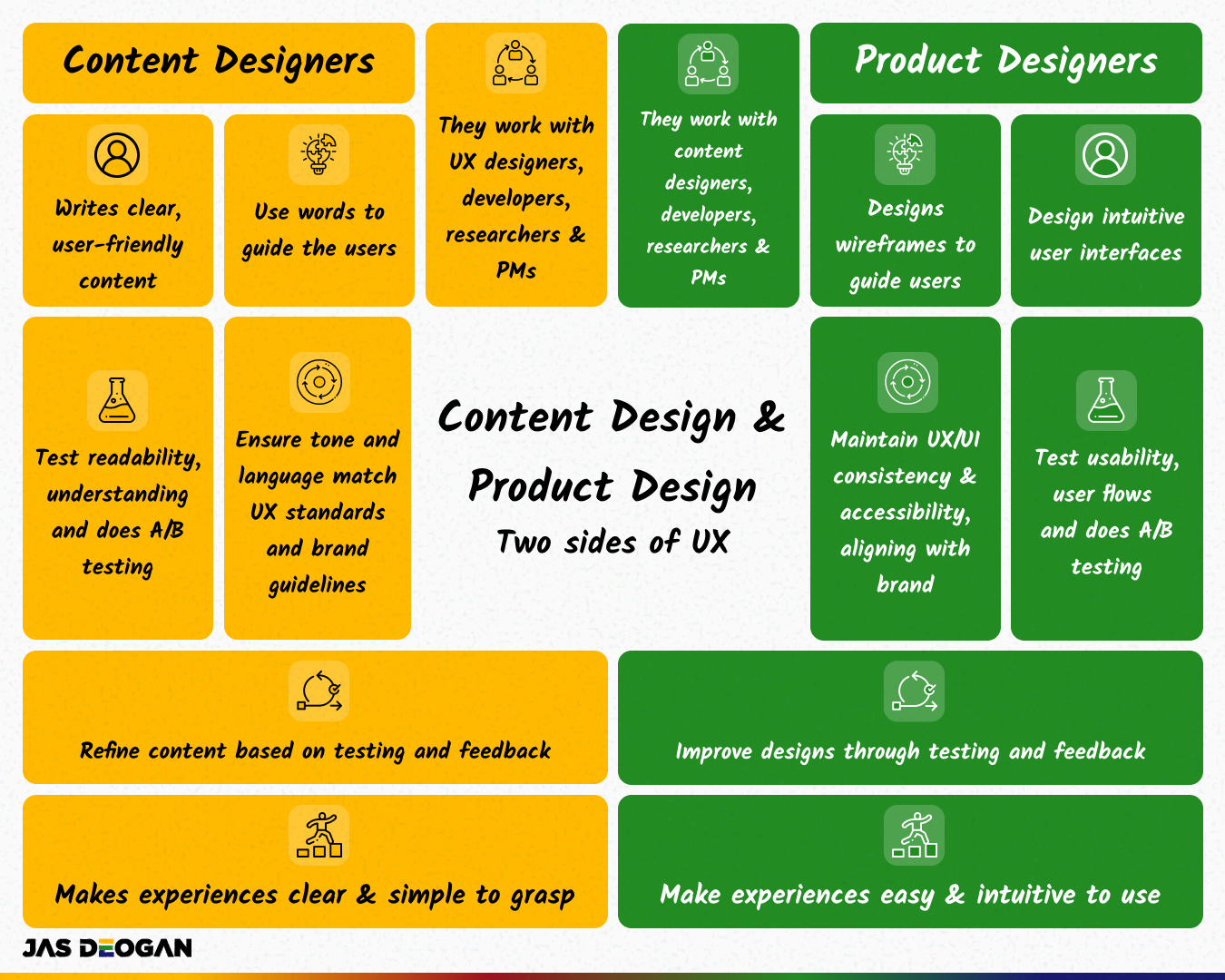
Content design and product design are two sides of the same coin: user experience.
Product design helps make an experience easy and intuitive to use. Content design helps make it clear, meaningful and possible to understand.
One without the other creates friction. A beautiful journey with unclear content is still a broken journey. Clear words trapped inside a poor interaction still fail the user.
For me, that framing helped. It made the role feel less abstract. It helped people understand that content design was not a layer added at the end, but part of how the experience worked from the beginning.
There is some irony in being a content designer who had to redesign the way he explained content design. But perhaps that is the point. Clarity is rarely instant. Sometimes you have to work your way towards it.
Being the only one is exciting and heavy
There is a lot I have enjoyed about these first 90 days.
A new industry. A new challenge. The opportunity to work with AI. The chance to shape something. The conversations with designers, researchers, product people, compliance and marketing.
Most of all, I have enjoyed seeing content design treated not as an afterthought, but as part of the future of the design practice.
But I do not want to make it sound easier than it has been.
Being the only content designer is exciting, but it can also feel heavy. You are doing the work, explaining the work, advocating for the work and trying to build better conditions for the work that comes next.
Some days feel energising. Some days it feels like a lot. And I cannot be everywhere at once. I have had to make deliberate choices about where I spend my time, where I can create the most value and what needs to wait. That has been a learning curve in itself.
Growth rarely feels clean when you are inside it. Confidence can look polished from the outside, while internally it feels more like doubt, recalibration, learning and choosing to continue anyway.
That has been the energy of these 90 days. I have not always felt settled. I have not always known the answer. I have had to learn when to get into the detail and when to step back. I have had to remind myself that being useful does not mean saying yes to everything. I have had to accept that building a practice takes time, and building one alone takes even more discipline.
If I only stay in delivery mode, the practice will not grow. If I only focus on strategy, the work will not land. Learning how to balance both is the job. It is my job.
What I have learnt about the craft
The biggest lesson from my first 90 days is that content design is moving closer to the centre of product decision-making. Not because the discipline has suddenly changed overnight, but because products are changing.
AI and conversational experiences are forcing teams to think differently about language. Content is becoming less static and more systemic.
It is no longer only what a user reads. It is what a system says, asks, remembers, refuses, explains and escalates. That means content designers need to widen the frame.
We need to care about copy, but not stop at copy. We need to understand journeys, systems, prompts, behaviours, risk, accessibility, trust and governance. We also need to remain humble enough to recognise that we cannot shape those things alone. The future of the craft will be collaborative.
It will require content designers to bring structure and intent while learning from the expertise around them. It will require us to hold the line on clarity and trust without believing we are the only people capable of creating them.
The role is not becoming less important. But it is becoming more connected. And the questions we ask need to reflect that:
Where does this content decision sit in the wider journey?
What does the system need to know before it responds?
How do we make the experience clear without making it feel robotic?
Where could AI build confidence, and where could it cause harm?
What needs a human decision rather than an automated one?
How do we design language that supports action, not only comprehension?
This is not about protecting an old version of content design. It is about being brave enough to help shape the next one.
The next 90 days
My first 90 days were about finding my feet.
Learning the business. Building relationships. Understanding the product. Getting into the work. Explaining the role. Contributing to journeys. Beginning to shape how content design appears in AI and conversational experiences.
The next 90 days need to be about focus.
Strategy. Principles. Patterns. AI guardrails. Conversational standards. Better documentation. Clearer decision-making. Stronger content maturity.
That is the shift I can feel happening now. From proving myself to shaping the work. From reacting to requests to building the practice. From being invited into conversations to helping define the conversations that need to happen.
I still have a lot to learn. About the industry, the products, the people and myself. But perhaps that is what belonging really looks like. Not arriving with all the answers. Not standing at the centre of the room pretending to know the way.
Just being willing to carry part of the map, listen to the people around you and keep moving forward. The belonging I was looking for was never behind me. It was always in the work ahead. And now, the work is here.
Over and out.